At no other time has a single meeting of the leaders of two democracies been so critical and hazardous.
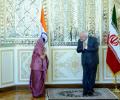
India's low passion, very cautious, relationship with Iran of the last 36 years awaits transformation, says Lieutenant General Syed Ata Hasnain (retd). Prime Minister Modi's visit cannot be a negotiating event; it is a symbolic one to strengthen the politico-diplomatic relationship.

The Mars mission is overwhelmingly irrelevant to space science and won't advance the frontiers of knowledge. It will divert attention from the real technological challenges facing the Indian space programme, and will further distort our science and technology priorities, says Praful Bidwai.

'We use the word "historic" perhaps too much, but the prime minister's visit certainly was historic in so many ways.'
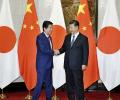
'Both Japan and China face a common challenge: How to deal with Trump.' 'The trade war with the US seems to have facilitated/hastened Abe's China visit, the first by a Japanese prime minister since 2011,' points out Dr Rajaram Panda.

At the summit, the US is able to play the role of a bully.

One of the most sought after exhibitions in Asia, as many as 549 companies are participating this year with 53 fighter aircraft on display.


'The range of purchases throw a light on India's threat perception as also its perceived role of being a stabilising influence in the region,' says Brigadier S K Chatterji (retd).

'Foreign policy-making cannot be shifted out of Delhi and the regional satraps, who do not have a national perspective, should not be allowed to dominate foreign policy. But regional inputs should be integral to foreign policy-making at every step of the way,' says Ambassador T P Sreenivasan.

New Delhi and Beijing are the only two regional capitals that have commented on US President Donald Trump's speech on August 21 outlining the way forward in Afghanistan. The Indian foreign ministry statement was effusive in praise, while the Chinese statement has been one of cautious and guarded hope. Delhi has identified itself with Trump's Afghan strategy, whereas the Chinese stance is calibrated -- observant and objective, keeping a distance, says Ambassador M K Bhadrakumar.
An obscure Indian bank has been an unlikely beneficiary of Western sanctions against Iran, handling billions of dollars from frozen oil payments that boosted its interest margins, but is now having to prepare itself for life after the windfall.

Narendra Modi's promise to allow states a bigger say in strategising and building foreign policy is unexceptionable, says TP Sreenivasan.

From being on the verge of war and violence, West Asia has actually got a sudden reprieve. Seema Mustafa explains

Prime Minister Narendra Modi had gone to China with a bagful of initiatives, but not all seems to have been fulfilled given China's reluctance to go the whole hog with him
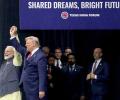
'The biggest takeaway is that the US-India relationship, which has sputtered a bit in recent months, enjoyed a big boost.'

While Nehru remains an icon for many, including his critics, for the stellar role he played in building institutions of democracy, the 1962 humiliation blots Nehru's copybook, says Colonel Anil A Athale (retd).

'The new generation voter is hyper-nationalistic, but it isn't essentially illiberal.' 'They will find the rants of Adityanath as laughable as Irfan Habib's. They will also find the BJP's polarising approach to vote-gathering unacceptable if it fails to deliver jobs and growth,' says Shekhar Gupta.

B S Prakash takes a tongue-in-cheek look at what India's neighbours think about the proposal of a SAARC satellite.

'We are completely engaged in fighting poverty; alas, our neighbour Pakistan seems only engaged in fighting us.'

For existing technologies, unless appropriate financing is available, deployment at scale is difficult.
The Aam Aadmi Party (AAP) has to deal with 3 powerful enemies: the media, the political establishment, and business houses.

When Obama signs the NDAA 2017 into law this week, the US-India partnership will be enshrined in US legislation, binding every succeeding administration, whatever its inclinations, to treat India as a 'major defence partner,' says Ajai Shukla.

Diplomats agree that amid stormy relations with China and Pakistan, Modi has posted impressive foreign policy successes, notes Aditi Phadnis.

'Those who have seen the functioning of the Modi government in Gujarat know that the issues related to Hindutva and issues of economy and growth function simultaneously.' 'Modi's politics are based on the understanding of the middle-class consumer society which is in pursuit of material aspirations.' Sheela Bhatt/Rediff.com reveals the Modi government's economic and political plans for the year ahead.

In the light of India's increasingly 'darkening' threat environment and the convergence of strategic interests between China and Pakistan, the IAF's declining combat capabilities are a cause for concern, says Brigadier Gurmeet Kanwal (retd).

'What Modisaab will accomplish by tampering with the treaty is providing ammunition to ultra-nationalist right wing elements within Pakistan who see India as an existential threat.'

'Crafting a coherent, transparent and consistent policy vis-a-vis our neighbours, leave alone the rest of the world, is unlikely to be high on the priority list of the new Indian government, which will be sworn in before June,' says Ramananda Sengupta.

'After a strategic pause though, Beijing will revive its policy of slowly creeping towards acquiring sovereignty over the South China Sea.'

This means lower losses on fuel sales by Indian oil companies and a shrinking oil subsidy bill for the government.
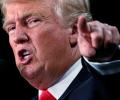
The US foreign and security policy establishment, says Ambassador M K Bhadrakumar, apprehends that Trump may compel them to exorcise the 'unipolar predicament', and bring foreign and security policies to reflect the desires and priorities of the American public.

'The Senators were playing safe, not angering either the pro-India lobby or the pro-Pakistan lobby, but perhaps more importantly, the military-industrial complex -- the most powerful lobby of all -- which the majority of Senators are beholden to in terms of largesse to their campaign coffers.'

The President talked about demonetisation, electoral reforms and disruptions in Parliament.

President Pranab Mukherjee on Monday addressed the first joint sitting of Parliament as mandatorily required under the Constitution after the general elections. The address is the political, economic and foreign policy road map of the Narendra Modi government and covers virtually all crucial areas.

Why is Xi Jinping visiting Saudi Arabia, Egypt and China this week? Former RA&W officer Jayadeva Ranade explains the significance of China's outreach to the Middle East.
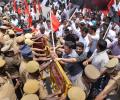
Protester Sasi Perumal's death has given a new fillip to the pro-prohibition movement, which was beginning to draw attention across Tamil Nadu after different political parties began to make it a part of their poll manifesto for next year, says N Sathiya Moorthy.

'As Mumbai showed, and the Nairobi Westgate Mall attack reinforced, "guerrilla-style terrorism" has increasingly become the method-of-choice for terrorist groups,' says terrorism expert David Kilcullen.

If the chemistry between Modi and Xi Jinping goes well, it will herald a new future not just for the region but for the world, says Tarun Vijay.

India's unusual tough stand on the arrest of its diplomat Devyani Khobragade has forced the United States to initiate an "inter-agency review" to look into the lapses that happened in the high-profile case that triggered an uproar in India and strained bilateral ties.
Arvind Kejriwal's party will need around 50 seats to make a pitch for the Left's space in national politics. For that, it will have to contest more than one third of the Lok Sabha seats, points out Saroj Nagi.
